Writing / Article
The Launch of the React Foundation Under the Linux Foundation
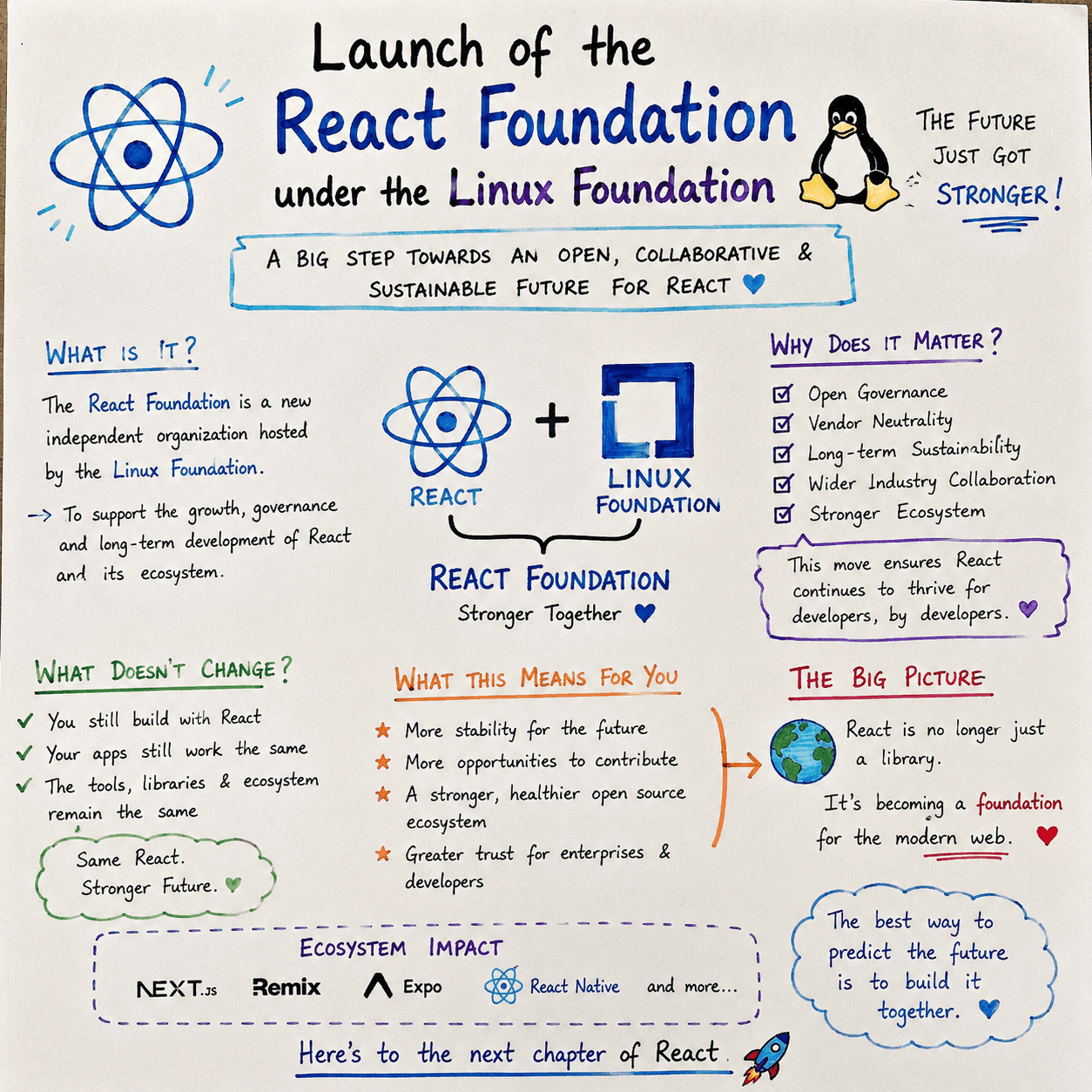
The launch of the React Foundation under the Linux Foundation marks a major turning point in the future of React. This blog breaks down what the Foundation is, why it matters for developers and students, how it strengthens the open-source ecosystem, and what this means for the long-term future of modern web development.
Prajwal V Naik
Researcher · Developer · Creator
What It Means for Developers, Open Source, and the Future of React
When most developers hear “React,” they immediately think of modern web apps, reusable components, and frontend development. But recently, something much bigger happened behind the scenes:
The React team officially launched the React Foundation under the Linux Foundation.
At first glance, this might sound like corporate or legal news. But here’s the thing — this move could shape how React evolves for the next 10+ years.
And if you're a student, frontend developer, startup founder, or someone learning React right now, this actually matters a lot more than you think.
What Is the React Foundation?
The React Foundation is a new organization created to support the development, governance, and future of React.
It operates under the Linux Foundation, which already hosts some of the biggest open-source technologies in the world like:
- Linux
- Kubernetes
- Node.js
- PyTorch
Official announcement:
React Foundation Announcement
Linux Foundation website:
Linux Foundation Official Website
Why Was This Needed?
To understand this, we need to go back a little.
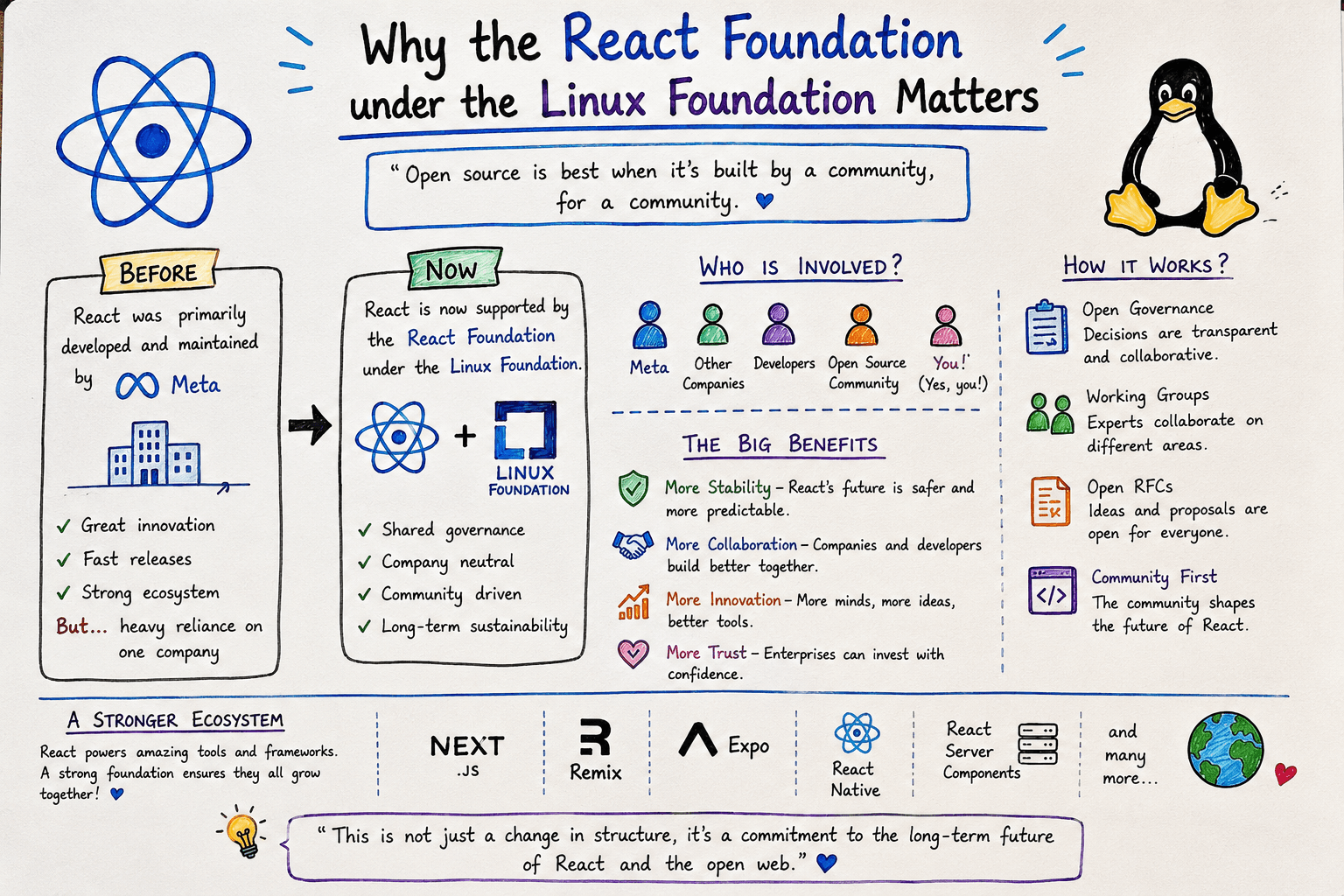
React Was Mostly Controlled by Meta
For years, React was developed mainly by Meta.
And honestly, Meta did an incredible job.
They:
- Built React
- Maintained React
- Funded core developers
- Released innovations like:
- Hooks
- Concurrent Rendering
- React Server Components
But there was always one concern in the developer community:
“What happens if Meta changes priorities one day?”
That’s a real problem in open source.
If a framework depends too heavily on one company, the ecosystem becomes fragile.
Why the Linux Foundation Matters
The Linux Foundation is known for neutral governance.
That means:
- No single company fully controls the project
- Multiple companies can contribute
- Decisions become more community-driven
- Long-term stability improves
This is exactly why technologies like Linux became massive.
Instead of belonging to one corporation, they became industry-supported ecosystems.
Now React is moving toward that same model.
Simple Real-World Analogy
Imagine your college project is maintained by only one student.
If that student leaves:
- the project slows down
- bugs remain unfixed
- nobody understands the architecture
Now imagine:
- professors contribute
- multiple students maintain it
- documentation exists
- responsibilities are shared
That project becomes sustainable.
That’s essentially what the React Foundation is trying to achieve.
What Changes for React Developers?
Here’s the good news:
For most developers…
Nothing breaks.
Your React code still works.
function App() {
  return <h1>Hello React</h1>;
}
Still React. Still components. Still hooks.
But the future direction becomes more stable and collaborative.
The Bigger Impact: Open Governance
This is probably the most important part.
Open governance means:
- More transparency
- Broader decision-making
- Better ecosystem collaboration
- Reduced fear of vendor lock-in
Companies feel safer investing in React when it’s not tied too tightly to one corporation.
That means:
- More enterprise adoption
- More tooling
- More jobs
- More long-term support
React Is Becoming Infrastructure
This is a huge mindset shift.
React is no longer “just a frontend library.”
It has become foundational web infrastructure.
Think about how many tools depend on React:
- Next.js
- Remix
- Expo
- React Native
Millions of applications rely on React daily.
So the governance model had to evolve.
Why Students Should Care
If you’re learning React right now, this is actually reassuring news.
Because it signals:
1. React Is Here for the Long Run
The industry doesn’t build foundations around dying technologies.
This move tells us React is expected to remain important for many years.
2. Your Skills Become More Valuable
Companies prefer stable ecosystems.
A framework backed by:
- Meta
- community contributors
- enterprise companies
- Linux Foundation governance
,becomes safer to adopt at scale.
~That increases demand for React developers.
3. Open Source Contribution Opportunities Increase
The Foundation structure often encourages:
- community participation
- working groups
- RFC discussions
- ecosystem partnerships
This can create better learning paths for new contributors.
A Quick Example of Why Governance Matters
Imagine this scenario:
A company builds a banking platform using React.
If React were fully controlled by one company:
- licensing fears could appear
- priorities might suddenly change
- development could slow down
But with foundation-backed governance:
- trust increases
- adoption increases
- enterprise confidence grows
That’s why this announcement is bigger than it sounds.
How This Could Shape the Future of React
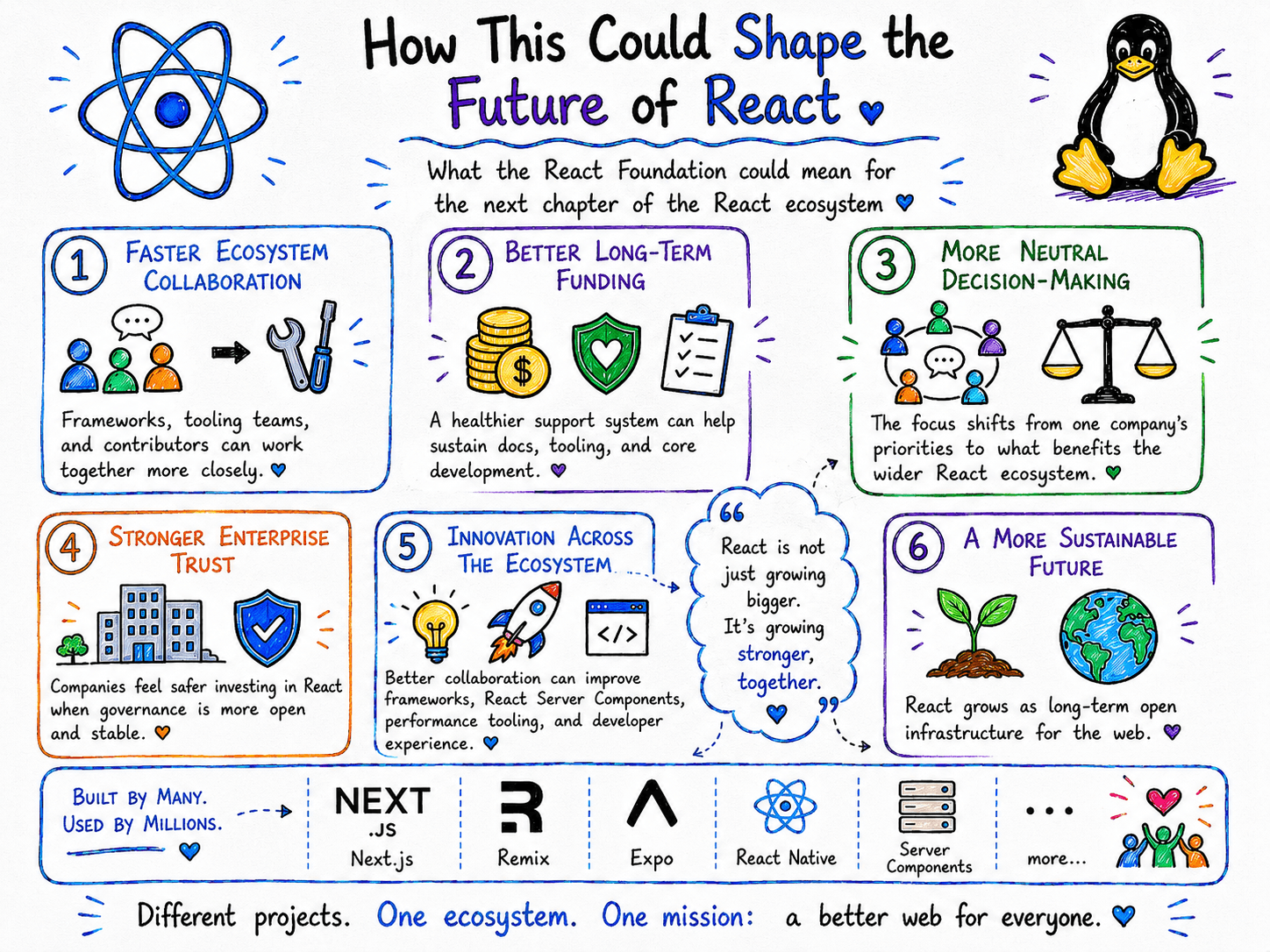
Here are some possible long-term effects.
Faster Ecosystem Collaboration
Frameworks and tooling companies may collaborate more closely.
Example:
- bundlers
- compilers
- testing libraries
- React Server Components tooling
could become more standardized.
Better Long-Term Funding
Open source maintainers often struggle with sustainability.
Foundations help organize:
- funding
- sponsorships
- contributor support
This can improve project quality over time.
More Neutral Decision-Making
Instead of:
“What does Meta want?”
The conversation becomes:
“What benefits the React ecosystem?”
That’s healthier for open source.
Does This Mean Meta Is Leaving React?
No.
That’s an important clarification.
Meta still plays a major role in React development.
But now React gains a more neutral organizational structure.
Think of it like:
- Meta remains a key architect
- the Foundation becomes the governing ecosystem
Example: How Open Ecosystems Win
Let’s compare.
| Technology | Governance Model | Result |
|---|---|---|
| Linux | Foundation-based | Global dominance |
| Kubernetes | CNCF/Linux Foundation | Industry standard |
| React | Moving toward foundation governance | Stronger future stability |
This pattern has already worked before.
Small React Demo for Beginners
Here’s a tiny example showing why React became so popular in the first place.
Traditional JavaScript
<button onclick="changeText()">Click</button>

<h1 id="title">Hello</h1>

<script>
function changeText() {
  document.getElementById("title").innerText = "React Changed Web Development";
}
</script>
Works fine.
But as apps grow, this becomes messy.
React Version
import { useState } from "react";

export default function App() {
  const [title, setTitle] = useState("Hello");

  return (
    <div>
      <h1>{title}</h1>

      <button
        onClick={() =>
          setTitle("React Changed Web Development")
        }
      >
        Click
      </button>
    </div>
  );
}
Cleaner.
Reusable.
State-driven.
That simplicity is why React exploded globally.
And now the Foundation aims to protect and evolve that ecosystem.
Important Resources
- Official React Website : React Official Website
- React Blog : React Blog
- Linux Foundation : Linux Foundation
- React GitHub Repository : React GitHub Repository
Final Thoughts
The launch of the React Foundation is not just an organizational update.
It’s a signal.
A signal that React has matured from:
- a library created inside a company
into:
- a globally governed platform for the modern web.
For developers, this means:
- better stability
- stronger ecosystem trust
- more collaboration
- healthier open-source growth
And for students learning React today?
You’re not learning a trend anymore.
You’re learning part of the internet’s infrastructure.
“Great technologies are not built by code alone. They survive because communities choose to protect, improve, and believe in them.” 🚀